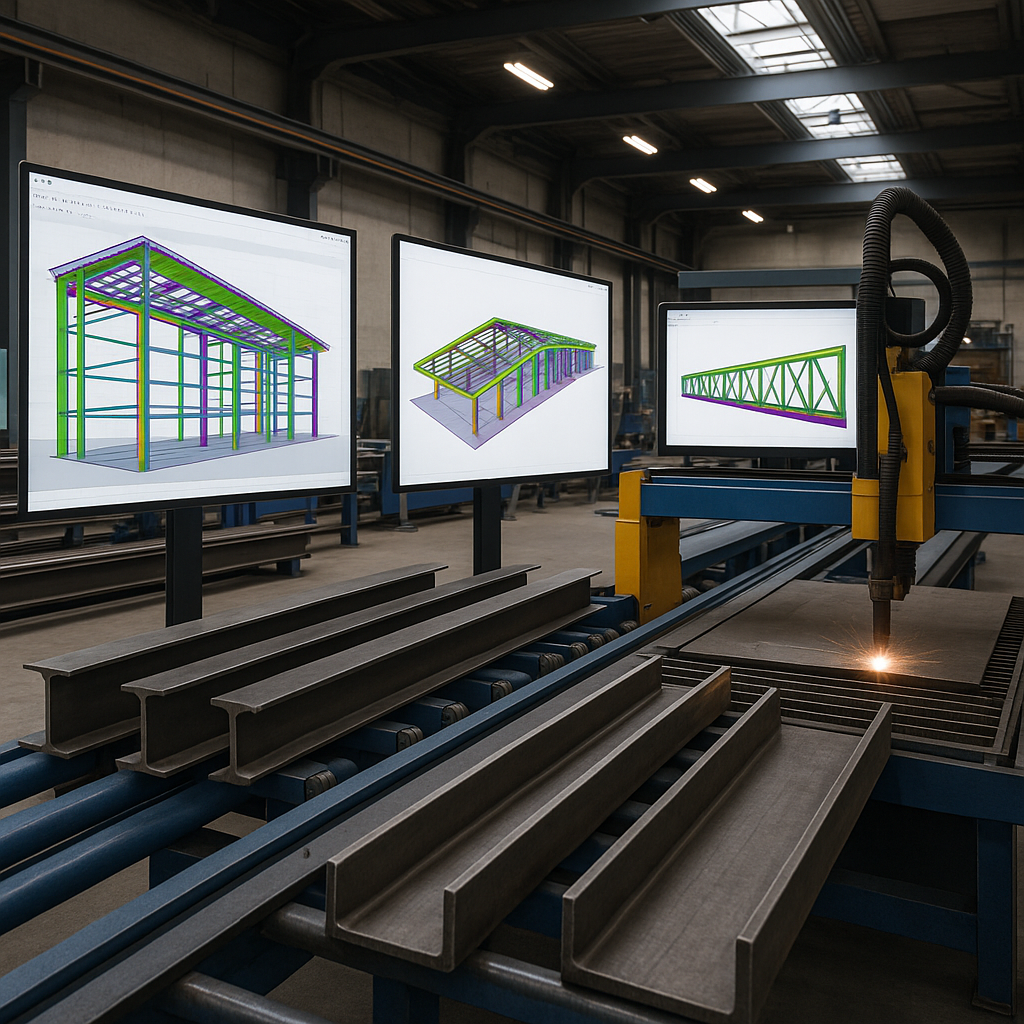
Discover how 3D BIM automation transforms steel fabrication workflows, reduces manual errors, and accelerates your project delivery from design through production.
Understanding 3D BIM Automation in Modern Steel Fabrication
3D BIM automation represents a fundamental shift in how steel fabricators approach their design-to-production workflows. At its core, this technology combines the information-rich capabilities of Building Information Modeling with intelligent automation tools that eliminate repetitive manual tasks, reduce human error, and accelerate project delivery timelines. For steel fabricators operating in today's competitive construction environment, understanding this technology is no longer optional—it's essential for maintaining efficiency and precision.
The traditional approach to steel fabrication often involves disconnected tools, manual data entry, and time-consuming processes that create opportunities for costly errors. 3D BIM automation addresses these challenges by creating a seamless digital workflow where design data flows automatically through detailing, fabrication, and production stages. This connected approach enables proactive planning instead of reactive problem-solving, giving operations managers greater control over project outcomes.
Modern BIM automation platforms create data-rich 3D models that serve as a single source of truth throughout the entire project lifecycle. These models contain not just geometric information, but also material specifications, connection details, fabrication data, and production sequences. When properly implemented, this automation reduces the frustration and time spent creating drawings while improving accuracy and traceability across all project phases.
The Critical Role of Automation in Design-to-Production Workflows
The journey from initial design to fabricated steel requires countless decisions, calculations, and coordinations. Without automation, each of these steps demands manual intervention, creating bottlenecks that slow production and increase the risk of errors. Automated design-to-production workflows transform this process by enabling seamless data flow between software systems, production machinery, and project teams.
When design changes occur—as they inevitably do in complex construction projects—automated workflows propagate these updates throughout the entire production chain. This eliminates the cumbersome spreadsheets and typo errors that plague manual processes, while ensuring that fabrication teams always work from current, accurate information. The result is a significant reduction in rework, site errors, and the time and money losses they cause.
Automation also enables steel fabricators to meet tight deadlines and complex project demands more effectively. By generating detailed drawings, reports, and machine-compatible data automatically from the 3D model, teams can focus their expertise on engineering challenges rather than repetitive documentation tasks. This shift in focus improves both productivity and job satisfaction, while delivering faster, more reliable results to clients.
Key Benefits: Precision, Efficiency, and Cost Reduction
The precision benefits of 3D BIM automation are immediately measurable. Automated checks verify that connections meet engineering standards, material quantities are accurately calculated, and fabrication data matches design intent before production begins. This level of accuracy dramatically reduces errors and rework, two of the most significant cost drivers in steel fabrication operations.
Efficiency gains extend across every phase of the workflow. Templates and automated processes facilitate design and sales activities, enabling faster bid preparation and more accurate estimates. During production, real-time visibility into fabrication status helps operations managers optimize resource allocation and maintain schedule predictability. The streamlined workflows from bidding to delivery reduce the overall project timeline, allowing fabricators to complete more projects with existing resources.
Cost reduction emerges from multiple sources: less rework due to errors, reduced material waste through optimized nesting and cutting, faster project completion times, and lower labor costs for repetitive tasks. These savings compound over time, improving profitability while enabling competitive pricing. Additionally, the improved coordination and effective collaboration enabled by BIM helps prevent costly site surprises and delays that can severely impact project margins.
Beyond immediate financial benefits, automated BIM workflows position steel fabricators for sustainable growth. The transparency and customizable calculation documentation provided by these systems builds client confidence and supports long-term relationships. The ability to handle increasingly complex connection geometries and project requirements opens new market opportunities that would be impractical with manual processes.
How Construsoft Solutions Enable Seamless BIM Automation
Construsoft provides a comprehensive ecosystem of advanced 3D BIM solutions specifically designed to streamline steel fabrication workflows. At the foundation is Tekla Structures, which creates accurate, data-rich models for design, detailing, fabrication, and construction. This software automatically generates detailed drawings, reports, and machine-compatible data, forming the digital backbone for automated fabrication processes.
For operations requiring integrated production management, Strumis and Tekla PowerFab offer all-in-one systems that connect project data and resources across estimating, purchasing, production, and delivery. These platforms automate purchasing and production workflows while integrating seamlessly with ERP systems and production machinery. Material optimization features and real-time production control capabilities help fabricators maximize efficiency and minimize waste throughout the shop floor.
Construsoft's solutions address the critical need for accurate engineering calculations through Tekla Tedds and IDEA StatiCa. Tekla Tedds automates repetitive structural calculations, eliminating cumbersome spreadsheets while producing transparent, professional documentation. IDEA StatiCa provides advanced design and code-checking for connections and structural elements using component-based finite element methods. Both integrate directly with Tekla Structures, ensuring calculation data flows seamlessly into fabrication models.
Collaboration capabilities are enhanced through Trimble Connect and Tekla Model Sharing, which enable multiple users and organizations to work together effectively. These cloud-based platforms support real-time data sharing, role-based access control, and intelligent conflict resolution—essential capabilities for coordinating complex projects across distributed teams. The extensive content available through Tekla Warehouse and Construsoft's exclusive library of add-ons further accelerates modeling workflows with proven, industry-specific components.
What distinguishes Construsoft's approach is the combination of powerful software with highly qualified support and training services. With 25 years of experience supporting customers at every step, Construsoft provides local expertise and guidance to ensure successful implementation and ongoing optimization. Comprehensive training programs, from Tekla Campus to hands-on practical courses, help teams build proficiency quickly while accessing a large user community for peer support.
Implementing Automated BIM Workflows in Your Operations
Successful implementation of automated BIM workflows begins with understanding your current processes and identifying the highest-impact areas for automation. Most steel fabricators find that starting with core detailing and fabrication workflows yields immediate returns, then expanding automation to estimating, production management, and collaboration functions as team proficiency grows.
The initial learning curve is a realistic consideration, but with proper training and support, teams typically achieve productivity gains within weeks. Construsoft's instructor-led and online training programs are designed to build skills progressively, from beginner concepts through advanced techniques. Hands-on practical courses ensure that team members can apply automation capabilities to real projects immediately, accelerating the path to proficiency.
Integration planning is critical for maximizing automation benefits. Evaluate how BIM software will connect with your existing ERP systems, production machinery, and project management tools. Construsoft's solutions are designed for seamless integration, with bidirectional links and standard data formats that facilitate connection with other systems. This integration effort, while requiring upfront planning, creates the connected workflows that enable proactive management and real-time visibility.
Change management deserves attention throughout the implementation process. Automated workflows change how team members perform their daily tasks, which can create uncertainty. Clear communication about the benefits—reduced repetitive work, fewer errors, better project outcomes—helps build buy-in. Starting with pilot projects allows teams to experience success in a controlled environment before scaling automation across all operations.
Ongoing optimization ensures that automation investments deliver long-term value. Regular review of workflows identifies opportunities to expand automation, refine processes, and adopt new capabilities as they become available. Construsoft's technical support and consultancy services provide expert guidance for continuous improvement, helping fabricators stay current with future-proof, innovative tools that maintain competitive advantage in an evolving market.